
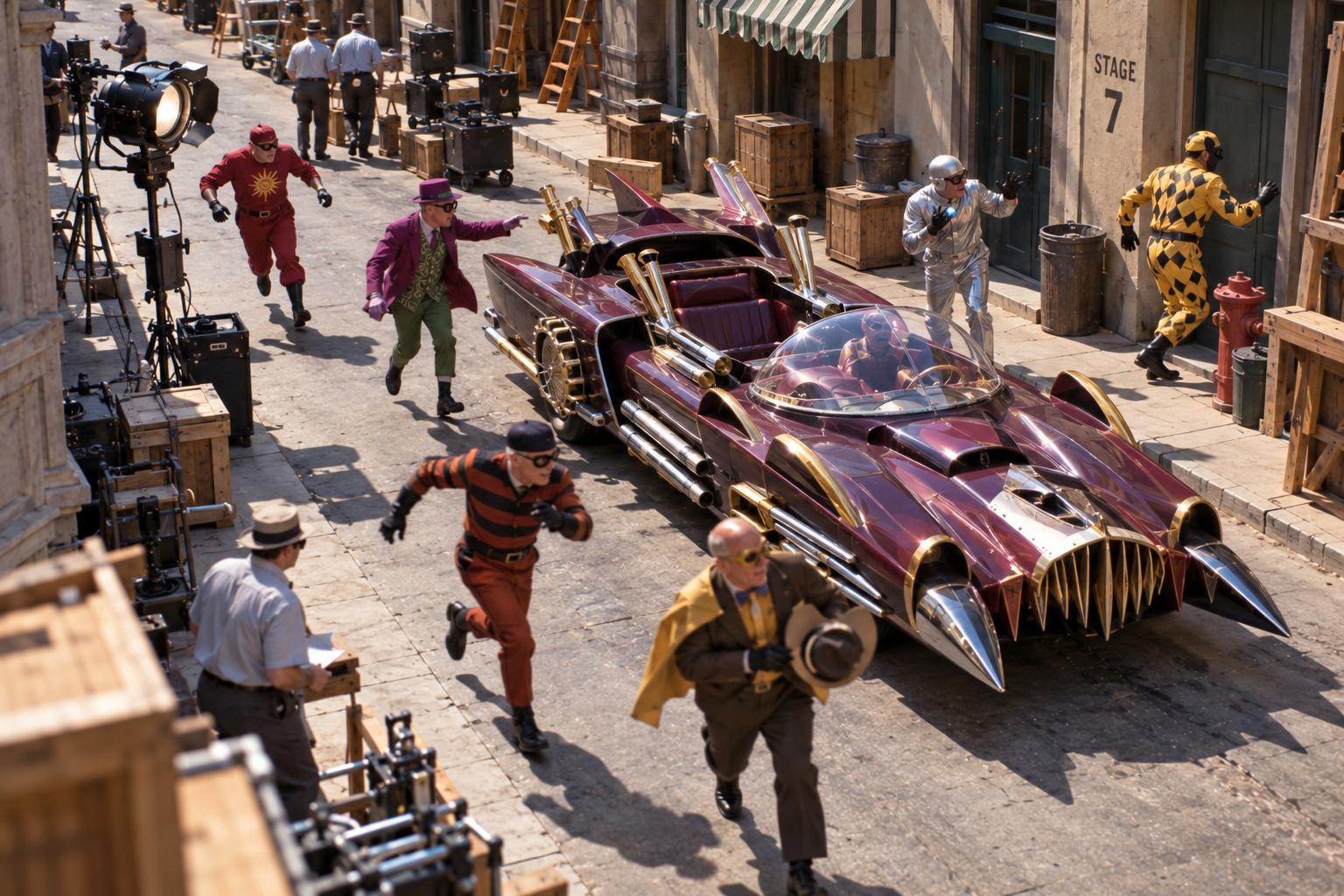
When I was growing up in Southern California, Hollywood wasn't some distant place that existed only on television. It was an industry, and like any other industry, it needed people who knew how to build things, wire things, move things—and paint things.
My dad was one of those people.
He worked for J. P. Carrol as a commercial painter. Dad was a serious, hardworking blue-collar man. He wasn't interested in glamour, and I don't remember him being particularly impressed by celebrity. Work was work. You showed up, did the job correctly, and earned your paycheck.
Every so often, one of the movie or television studios around Los Angeles needed extra contract labor. When that happened, painters like my father might find themselves working on a studio lot instead of an ordinary commercial job.
That meant Dad occasionally got to see Hollywood from a perspective most television viewers never did.
He saw it from the other side of the scenery.
The streets that looked like real neighborhoods on television might be surprisingly short. Buildings that appeared substantial from the right camera angle were sets. Perspective mattered. The camera saw only what somebody intended it to see.
And just outside that carefully constructed rectangle were painters, carpenters, electricians, grips and other tradesmen doing perfectly ordinary jobs.
On one of those occasions, Dad was working on a set near where the original Batman television series was being filmed.
For a kid in the 1960s, this should have been astonishing.
Batman wasn't subtle television. Gotham City was filled with impossibly colorful villains, elaborate hideouts, outrageous automobiles and fights in which punches practically exploded off the screen. Batman and Robin could climb the side of a building, leap into the Batmobile and race across Gotham City to save the day.
The program knew exactly what it was doing, but children didn't necessarily see the joke.
We saw Batman.
Dad saw something else.
He came home that evening talking about the grown men he'd seen running around the studio in funny makeup and ridiculous outfits.
He thought they looked foolish.
I can still appreciate the disconnect.
On television, dramatic music was playing. The camera was low. The colors were bright. The villains were menacing. Somebody was undoubtedly plotting the destruction of Gotham City.
From Dad's vantage point, there was no dramatic music.
There was probably a man in work clothes carrying a paint bucket.
And fifty feet away, some grown man in tights and makeup was strutting down a fake street.
Dad wasn't seeing Gotham City. He was seeing a workplace.
That distinction has stayed with me because it revealed something about both Hollywood and my father.
Television depended upon controlling what we saw. A narrow studio street could become a city if the camera was placed correctly. A painted wall could become a building. A collection of lights, lumber and scenery could disappear completely once the director framed the shot.
Everything outside the frame ceased to exist.
But Dad lived outside the frame.
His world was ladders, drop cloths, brushes, paint cans and getting the job finished. The illusion wasn't intended for him. He was standing close enough to see where it ended.
I don't remember Dad coming home excited that he'd been near the set of a famous television program. I remember him being amused by how silly the whole thing looked when you removed the camera.
As a child, I probably would have preferred his story if he'd come home having met Batman.
Years later, I think the story he actually brought home was better.
Somewhere on a studio lot in Los Angeles, Gotham City existed for exactly as long as the cameras were pointed at it.
And just beyond the edge of the picture, my dad was painting.
Comments